Saturday, June 23, 2012

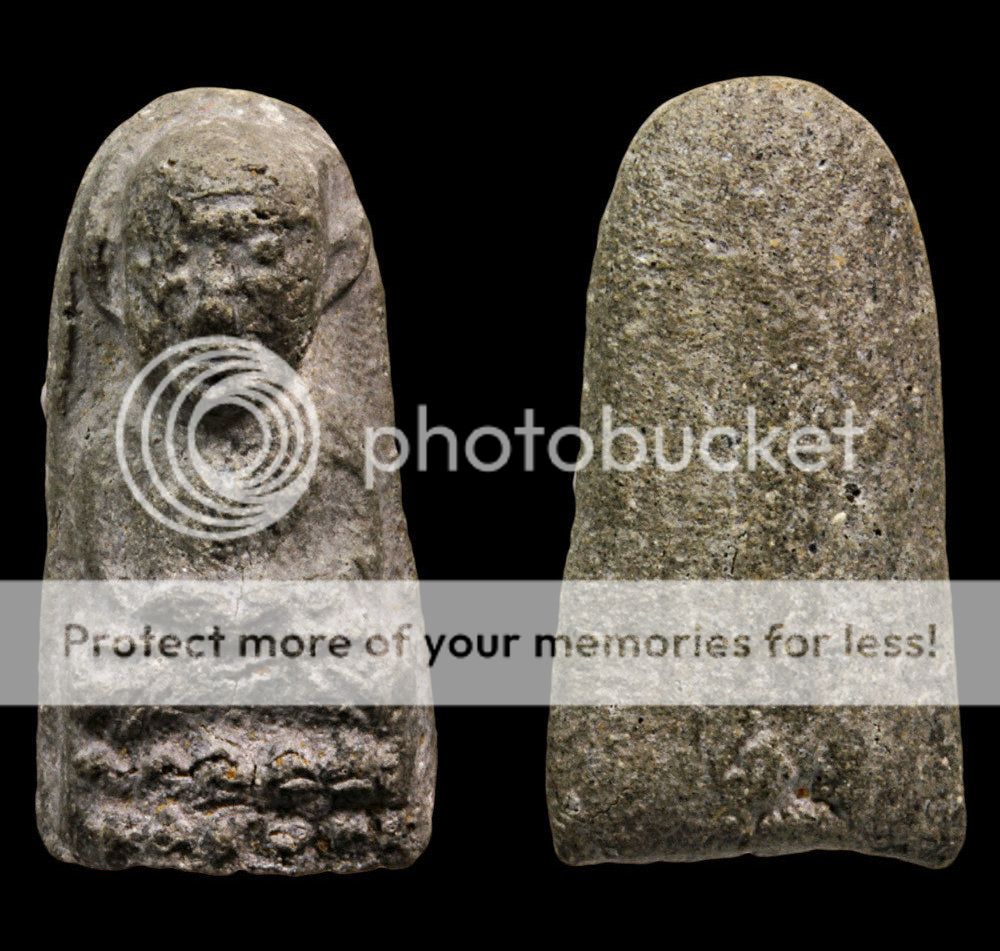
Phra Perd Maan, Wat Nok, pim lek, 2460s (2nd Placing)


Some Info:
Phra Somdej Wat Nok (AngThong Province) were consecrated by Luang Phor Ferng, Luang Phu Thong and Luang Phu Suk (Wat Makham Thao, Chainat) whom they were pals and often met in consecration ceremonies both in their temples and elsewhere.

Luang Phor Ferng learnt Dharma and Wicha Akom (magical power) from the abbot of Wat Nok and had learnt from many masters during his tudong in the forest. Luang Phor Ferng was a highly respected monk at his time, even Luang Phor Klan of Wat Prayathikaram had high respect for him.

The materials used for making Pra Somdej Wat Nok were from various kind of herbs, holy powders from Luang Phor Ferng and Luang Phu Thong. These also included the powders collected during the drawing different types of Kom and Yant (magical scriptures) and sugarcane juice as harderner.

As informed by the elders from the villages around AngThong province, Pra Wat Nok were very efficacious for Metta Maha Niyom and Kleaw Klart (prevent bodily harm).

Pra Kru Wat Nok – LP Ferng Angtong , Biodata
Wat Nok , official name, Wat Sakunaram, is a famous temple of Angtong Province. Established during the Kingdom of Ayudhya it was deserted for decades until renovated by Luang Poo Ferng, a monk better known for the creation of Pra Wat Nok amulets.

These beautiful century old amulets are full of charactersitic and beautifully preserved. Whats more they are more than affordable.

It is generally assumed that Luang Poo Ferng had created the Pra Wat Nok amulets around BE 2460 to worship Lord Buddha.

Most of the amulets were given to those that had supported the renovation of the temple, Luang Poo Ferng passed away in BE 2467.

Both LP Ferrn and LP Suk, Wat Makhamtao were good friends and it is clear that the design of the Wat Nok amulets used many of the design elements of those created by LP Suk.

Pims
-Pim Somdej 3 Chan
-Pim Somdej Tarn Koo
-Pim Somdej 5 Chan (Buddha Image on five-level base)
-Pim Sum Rern Gaew (Buddha Image with classical roof)
-Pim Sum Prasart (Buddha Image with ancient Khmer castle)
-Pim Nang Kwak
-Pim Khang U (Buddha Image with U, the sacred spell, to9 both right and left.)

Pra Wat Nok amulets are fairly robust pims due to a combination of the composition and drying process over decades.

Generally these amulets can be found in 4 colour variations, black, grey, yellow, brown. The colours caused by the materials used to create the amulets and the reaction with the environment,

Sacred Kru

After Luang Poo Ferng hjad created these amulets the majority were either stored within a Kru or placed within a scared Chedi at Wat Srakes, Angtong province.

Luang Phor Toh, then abbot of Wat Srakes, Arngtong Province, had discovered the Kru which he opened. The amulets were again distributed to new worshippers who had supported the temple’s renovation project.

Luang Poo Fern
Little is known about Luang Poo Ferng, the monk that had created these amulets. What is known is that he was a quiet and dedicated monk who preferred to practice and study sacred sciences alone.

It is recorded that he had been offered high ranking positions on a number of occasions and refused not wanting recognition beyond his current status.

Ultimately he was to become one of the most highly respected and sacred monks of his generation.

Despite the lack of information available from the archives there are many accounts of the efficacy of his amulets.

A typical example is that of a physician, who said that he was involved in collision with a truck whilst driving his motorcycle. He was dragged for 20 meters but was spared major injury. Witnesses to the accident were sure of his death but attributed his amazing good fortune to the single amulet that he was wearing from Wat Nok.

Note that biography of LP Fern is researched and prepared by buddhist-amulets.com. Used under permission from copyright owner: Buddhist-Amulets.Com


The main point of collecting Wat Nok, amulet was mixed with Bailan powder chanted by Lp Suk of Wat Mak Kam Tao. caz abbot of Wat Nok, he is junior and Lp Suk is senior. good relationship between them. As historical record, Lp Suk sometimes invited abbot of Wat Nok, co-chant amulet or even taught him "Khata and Mantra".

My piece shared, is "doo ngai". Look greenish with glossy look.

Tuesday, June 19, 2012

LP Thuat Wat Prasat 2506 Pim Jew

Sharing an excellent condition LP Thuat from wat prasat 2506, pim jew (mini). Nur wahn. This piece is very dry, just like 2497 Wat changhai LP thuat. What makes this piece special:

1. Pim jew is rare as compare to pim Yai. And this piece is kamakan pim.

2. It uses LP Thuat Lang Nang Seur small 2505 as pattern.

3. This piece has mixed with 2497 wahn and other powder from top monks of that era. and it has gone through a super big scale consecration ceremony. Refer to my older post on wat prasat batch.

Enjoy!


Somdej Wat Rakhang Roy Pee 2515 (1st Placing)

Sharing a nice piece of Somdej Roy Pee (100 years anniversary). Wat Rakhang, 2515. Pim Tor. 1st placing in recent Samakorm Competition on 27th May 2012

Roy Pee is well known among seasoned collectors. It has mixed with lots of old Somdej Wat Rakhang powder or broken fragments of it. So, widely regards as a must have for somdej collectors.

Enjoy!

LP Thuat Wat Changhai 2524 Pim Phra Rod (1st Placing)

Sharing another piece of LP thuat 2524 from Wat changhai, pim phra rod, nur wahn. Pim Phra Rod has gained lots of popularity recently as pim yai is quite easy to find in the market and pim kamakan has lots of fake or remake one in the market. So, phra rod pim has gone from S$300 a piece few years back to the now current price of S$600-900. A top piece with 95% condition is even asking for 25,000 Baht. And price will continue to go up as 2524 is proven effacacious with lots of miracles. A good replacement for 2497 AC Tim, Wat changhai LP thuat if one can't afford one. 2524 is mixed with lots of 2497 wahn.


This piece was submitted to a major conpetition sometime back and awarded 1st placing.


Somdej Phra Kru Moon, Wat Suthat 2495

Sharing a piece of nice somdej made by Phra Kru Moon of Wat Suthat in 2495.

Phra Kru Moon has collected lots of Somdej Wat Rakhang old Powder himselves and from Sankaraj Pae. Thus this batch of somdej was mixed with lots of old somdej Wat rakhang powder and other holy herbs and dried plants collected by Phra Kru Moon for a long time.

Nowadays, even somdej 2509 from BKP command high price tag even though a smll amount of old BKP powder mixed into it. Thus this batch of phra kru moon somdej is definitely more worth to collect both for wearing or collection.

And a note of caution. many people confused this with somdej phra kru moon made by wat prasat in 2506. Wat prasat made a somdej similar to this to commemorate phra kru Moon but i don't think phra kru moon himselves participate in wat prasat consecration ceremony. and the price is also lots of difference. This piece below is almost double the price for somdej phra kru moon by wat prasat.

Enjoy!


LP Thuat Wat changhai Taurit, 2539 Nur Ngern and Thong Tip


Sharing a nice piece of LP Thuat Taurit, made by Wat changhai, year 2539. This batch was consecrated in a big ceremony with many top monks of the era attended the ceremony.

Prices has been climbing up steadily due to limited qty produced. High demand in the market.

Gold Taurit made only299 pieces, pink gold 299 pieces, silver 4999 pieces, thongtip 4999 pieces and nawa, 14999 pieces. There is also Nawa with red longya version which believed to be made <100 pieces.


1. Nur ngern. Pim yai. Excellent condition. Made 4999 pieces only.


2. Nur thong Tip. Pim kamakan. Mint condition with temple box still. 6 codes. Specially made for temple committee. Believed to be made less than 40 pieces.


Wednesday, June 13, 2012

LP Peuak of Wat King Keaw


Luang Phor Peuak Pun-yataro was born in Bangpli District, Samutprakarn Province on Thursday August 12th, B.E.2412 to the family of Mr.Tongsuk Koomsuktong and Mrs.Khai Koomsuktong.

Pra Acharn Im Intrasaro, the second abbot of Wat King Keaw was his first sacred teacher having being taken there by his father at the age of 13 to be educated.

At the age of 18 he enlisted for military service for afew years, before returning to Wat Kingkaew in B.E.2433 where he was ordained by Luang Poo Tong, a senior monk of Wat Rach-yota(or Wat Rachbuakhao) and Pra Acharn Im Intrasaro, who acted as his Pra Upacha and Pra Karmavajacharn respectively.

He dedicated his life to the Buddhist faith, learning Dharma and meditation with Pra Ajahn Im Intrasaro, who was impressed by his honesty to Buddhism.

Several years later, Pra Ajahn Im Intrasaro passed away and the people of the province invited Luang Phor Peuak to become the new Abbot, aged 30, having served Buddhism for only nine years.

During his administration it is known that he built and repaired many structures within the temple grounds and surrounding areas including the sacred chedi, Pra Viharn, Dharma schools, primary schools etc

Moreover he also built a sacred Buddha Image, designed after Pra Chinraj, Pitsanuloke Province. Today this image still represents the temples’ principle Buddha

Note that this biography is researched and prepared by buddhist-amulets.com. Used under permission from copyright owner: Buddhist-Amulets.Com

Friday, June 1, 2012

Luang Poo Doo Biography

Luang Poo Doo
May 10th 2447 - Jan 17th 2533


Luang Poo Doo (officially called “Pra Prompunyo”) was born on May 10, B.E.2447 in Uthai District (Ayuttaya Province). His parents Mr.Put and Mrs.Puang were farmers. It seemed like he was destined to be a famous monk since the day he was born was one of the most important Buddhist days, called “Visakha Bucha Day” - a day to commemorate the birth, enlightenment and death of Lord Buddha.

CHILDHOOD:

Floating baby story

He was just a little baby when a strange thing happened on one rainy day. It was raining so hard that their house and all the surroundings were flooded. The parents was very poor and therefore aside from daily farming they were also making little snacks to sell at the downtown-market. On that day, while they were cooking, they suddenly heard the dogs barking loudly. When they came out to see what was going on they almost fainted because their little baby, Doo, was floating on the river, flushed away from the yard by the quickly growing stream. The baby was lying on a big pillow, which helped to save him from drowning and Mr. Put managed to bring the boy back home. However the incident made his parents believe that their baby had some magic power that had helped saving his life - otherwise he would have been killed by the wild river.

Poor orphan

Unfortunately Mr.Put and Mrs.Puang had no chance to see Luang Poo Doo ’s success in the priesthood as they both passed away around the time when Luang Poo Doo was just 4 years old. He had become a little poor orphan who was raised by his grand mother and sisters. They later sent him to be educated at Wat Pradoosong Dharma.

EDUCATION:

Luang Poo Doo had begun his education at Wat Pradoosong Dharma, where he was ordained as a novice. When he’s 21 years old (May 10, 2468), he was ordained as a Buddhist monk at Wat Sakae by another famous sacred monk named Luang Phor Klun, the abbot of Wat Pra Yatikaram (as well as Luang Poo Chai, the abbot of Wat Klang Klongsrabua and Luang Poo Dae, the abbot of Wat Srakae). After that he had moved to stay at Wat Sakae to continue learning higher levels of Lord Buddha’s Dharma as well as to spend the most of his life. Soon he started learnig Dhamma from many senior monks including Luang Phor Klun, Luang Phor Nueng, Luang Phor Chom, Luang Phor Rod and Luang Phor Pao. Particularly Luang Phor Klun had taught him about meditations, which was the most important science that would later helped him to become a famous magic-power expert, as well as Luang Por Pao, who was teaching him a lot of magic sciences which later helped to create sacred amulets to help protecting people from danger and evil.

MAGIC SCIENCE:

Luang Phor Doo, just like other sacred monks, tried to learn various magic sciences. To get the right experience he set out for travel to the deep forests in Karnchanaburi and Supunburi Province. He also stayed at the very respected sacred shrine “Pra Tandongrung”. It was recorded that at the time he was very interested in sacred tattooing, and got tattooed on the most of his body. However later, when he grown older, he considered that sacred tattooing was just a magic science that does not really help people being truly unleashed from the circle of creatures (comprising the birth, aging,, being ill and dying). That's why he had turned to be more interested in meditations, which was accepted as the best way to help developing the human soul to be purified and powerful enough to leave the circle.


MEDITATION AND OTHER SACRED TEACHINGS:

Actually Luang Poo Doo was really lucky because of his teacher Luang Por Klun, who showed him how to practice meditation by controlling his breath by both, the inhalation and exhalation. By the way, when he inhaled he would say “Buddh” and when exhaled he would say “Dho”. By the practicing his mind, one becomes to be more and more purified and his soul would get closer and closer to Lord Buddha. For ordinary people it isn't that simple because human hearts naturally lack the concentration. Sometimes you might be worried about your family, your children, your businesses etc, and therefore it is quite necessary to practice meditation at the right place and under a sacred control and help of monks. That’s the main reason for some people can be successful in meditation while others are not. All the people, who were led by Luang Poo Doo were really lucky because apart from the senior monk’s heartfelt dedications, his sacred power would also help to protect the peoples' souls from spirits that might try to obstruct or disturb them while they are meditating.

A spell to get rid of thieves story

There was annoying period when Wat Srakae was often visited by thieves who kept regularly stealing various things. LP Doo was trying to find a way to get rid of them and he had found the name of “Archarn Choti”, a famous ancient monk, who used to have a special spell that could help tu push the thieves away.

(note: Acharn Choti, was an ancient Buddhist monk who is famous in the Thai history. Around 250 years ago, when the Burmese armies had invaded the Kingdom of Siam(Thailand), Archarn Choti led a group of people in Bang-rajun Village, a group of villagers with almost no weapons to fight and kill Burmese invaders .)

Thus, LP Doo kept praying and asking Archarn Choti in his dreams for the spell, but there was no responses until several years after, when Luang Poo Doo almost forgot about the issue:
A young man visited Wat Sakae and was ordained a Buddhist monk by LP Doo, who had also helped teaching him to practice meditations. After some time this young monk approached LP Doo with an amazing question.
“Have you ever known Archarn Choti?” The question really surprised LP Doo since he had been waiting for many years for any response from the ancient sacred monk.
“Yes, I have.”, replied Luang Poo Doo.
“Archarn Choti had come to me in my meditations and wished to tell you that you should be interested in that sacred spell because these spells are black magic and it would hinder you from your future enlightement.”, said the young monk.
A lot of witnesses were present and could hear their conversation. They could also hear Luang Poo Doo saying: “Actually, I almost forgot about the spell already because too many years had passed. But eventually Archarn Choti gave me the answer through you.”

“Kumarn Hoo-tum” story

Luang Poo Doo was very famous for his simple way of teaching Lord Buddha’s Dharma. He would always tell an easygoing story that could be easily understood by the rustic local people to help them find the true instructions of Lord Buddha. One of his most famous story was called “Kumarn Hoo-tum”. The story was about a millionaire, who was mean and never wanted to pay money in any way even when his son named “Kumarn Hoo-tum” got seriously ill and needed some help. Eventually the boy died. Because of the mercy of Lord Buddha, before he had seen a miraculous light, caused by Lord Buddha’s sacred power. He recognised that the light Lord Buddha's mercy for all creatures. At that moment the boy fell to respect to Lord Buddha and after his soul had left his body he was born in heaven and was renamed to “Mutta Khuntasi Dhepbutra”, and blessed to stay in heaven forever.

Mercy for all

Luang Poo Doo was famous for his mercy for all creatures and everyone, who visited the temple, would be allowed to touch his mercy. LP Doo would never refuse welcoming them despite being very tired, after working hard all day.

IMPRESSIVE WORDS:

“Just only thinking of Lord Buddha’s mercy could cause you a lot of virtues. Therefore if you often remind yourselves of Lord Buddha, Dharma and Sangkha you would surely gain lots of virtues that would lead you to heaven after you have passed away.”, used to say LP Doo.

“If you want to be successful you must begin to do something, not just only waiting for miracle to help you. Lord Buddha is the best example, he went through everything - he suffered from various tortures before he could be enlightened and so should do all the creatures, if they want to follow Lord Buddha’s way. Just begin today, and success will be waiting for you indeed - sooner or later, it just depends how hard you’ve tried. ”.

WEAK HEALTH:

In around B.E.2527 Luang Poo Doo ’s health became worse. He had to visit the hospital several times, and was found to have a serious heart disease. Although it was suggested to him to stay at the hospital for many times until his heart becomes better, he refused and stayed at the Wat. He was simply felt so responsible for the Buddhism activities and all of his followers at the temple. LP Doo kept on hard working until the year B.E.2532. Lots of people were visiting the temple to listen to his teachings, without realising that the old monk was seriously ill. LP Doo never complained about his weakened health, he had just kept on teaching Lord Buddha’s Dharma to all visitors.
In the morning of January 16, B.E.2533, Luang Poo Doo welcomed the visitors with his face smiling as usual. No one seemed to be alerted that this famous monk would leave his body tomorrow. In the next morning ( January 17, B.E.2533, at 05.00 a.m.) the monks and novices in the temple found Luang Poo Doo passed away. He was 85 years and 8 months old. His body was buried during the official funeral under the King’s patronage on April 20, B.E.2534. He had served Buddhism for 65 years.
Although LP Doo has been away for more than 16 years, lots of people keep visiting Wat Sakae every year to organize a Buddhism ceremony dedicated to him and his work that helped to lead many people to successful ways of lives.

SACRED AMULETS:

Due to his reputation in possessing supernatural powers and mastering magic sciences, many people seek his amulets. Many stories about his amulets' supernatural power are circulating among Thai people (the amulets saved many lives and some of them also helped poor people to win lottery prices). Because of their brilliant reputation it is quite hard to get a genuine amulet by Luang Poo Doo. Besides the fact that there is always a huge lot of fakes at Thai amulet market, Luang Poo Doo made so many series of amulets that it is really difficult to remember and distinguish between the true and fake amulets.
The most famous of his amulets are probably the silver rings. They were made of 12.6 - gram gold and called Prohmpun-yo rings. Others are phra phrom and lp thuat.

Also, one of LP Doo ’s most famous series of sacred amulets was called “Rian Perdloke (= Open The World)” - a sacred coin with the portrait of Luang Phor Tuad embossed on the front side and on the sacred endorsement and the name of Luang Poo Doo of Wat Sa-kae on back, together with the Thai number identified B.E.2532 (which was the year that this series of amulets was made). The followers of Luang Poo Doo revealed that Luang Poo Doo would tell them them that while he was reciting the sacred spells to create the Rian Perdloke his mind could touch a miracle light that had penetrated into the three worlds.

Friday, May 25, 2012

My Way Of Collection

My way of amulets collection now:

1. 50% of money : high end collection. Those that are above S$1,000. Highly collectable and easily resellable if needed. With standard market price. Can inherit to my son in future or resell it for retirement:)

2. 40% of money: mid end collection. Anything between S$200-S$1,000. For investment. Gain uses to fund class 1 purchases.

3. 10% of my money: for amulets that i like. May be from good luang phor. or with good cause. or amulets hot in current market.

So, i have three buckets with different amount of money. i will split my monthly disposable income into these three buckets. Only purchase with money from these buckets and not anywhere else.

I used to pawn my Rolex, sell my Panerai to fund my amulets purchase. i decide to stop this from now on. It becomes a burden and it disrupts my other expenses important for my family.

Haha...hope this works....i am trying it out now.

Sharing Amulets Collections Experience

I have been collecting amulets for many years now. It started when my dad brought me to late night gathering with fellow collectors. i hated him and didn't understand why he can spend countless nights and days with this hobby. i was Sec 3 then. i missed my classes, missed my sleep and many good times with friends. Just to accompany him.

Until much later when i was into this hobby myself, then i realised. i might be doing the same too if not for my two little toddlers who had kept me busy day and nights. Somehow it is different from other hobby like stamp collection or bird watching. It can keep me excited days and nights and for many years.

Now that my dad passed away. Last year Sept. i started to take over all his collection. He only willed few pieces to my sisters and his grand sons. The rest, all go to me. I am the only one collecting and into this hobby actually.

Now there are a few lessons that i want to note down and share. Just to share my experience and lessons learnt from seeing the way that my dad collected his amulets.

1. There is no free lunch in this world. Good amulets doesn't come cheap. If a seller knows the background of the amulets and if he still wants to sell you the amulets at a fraction of the amulets actual market cost, then you better think twice before getting it.

2. Amulets collectors are to certain extend smart and "cunning". They are very familiar with the buying behavior and pattern. If you think you out smart him, many a times it is the other way round. There are many crocodiles around.

3. Do not anyhow collect amulets without a clear purpose. Don't follow crowd or trend. Know what you want and go for it. You might end up collecting lots and lots of amulets and at the end of the day, 20 years later, you don't even remember its name and its origin. Just like my dad. And more so, if you want to resell your amulets later on.

4. Focus on your collection. Be an expert in one material or one Luang Phor. It is hard to know and master everything. find a good luang phor thatyou like and get all information about him. Collect only his amulets. Then move on the the next. If you collect only metal, then make sure you understand how a rian is made. What are the different process involves and how to see sign of aged. This is more important than memorizing all the marking. Marking can be made almost 100%.

5. There are many "expert" in this field. They seem to know everything and all kinds of amulets. So, practise your judgement and analysis skill when digesting inputs from these "experts". You might need more than one views to decide.


I searched through all my dad's collection. i am of course happy that i have a lot of amulets now. But amulets that are real, may be 70%. Amulets that are worth collecting (from my perspective), may be 30%.

Amulets that are really collectable, real, costly (more than S$2,000), less than 20. I felt a bit sad as he has spent tens of thousands of dollars into this. This is his fortune. He does not left any money behind for us. Is it worth it?? i am not sure.

For him may be yes. for me, i learn from this and refine my purpose of collection and zoom into what i really want. :)

Luang Poo Doo (Wat Saket) and amulets

The following is a translated article regarding pratard or dharmatart popularly found on luang poo Doo's amulets. The study was done by a PHD student and was written in his thesis on using amulets as a meditatin subject. And since he touches on LP Doo who is one of my favourite monks, i thought of sharg this to my followers :)


Luang Poo Doo or Phra Phrompanyothera was most renowned among meditation practitioners in Thailand because of the amulets that he made and supplied to his disciples for holding during meditation. There is a controversy surrounding these amulets. It involves crystallized calcium (Pratard or dharma Tard)of different shapes that emerges on the surface of the amulets after they have been used in meditation for a period of time.


There are two sides to this controversy. On the one hand, his disciples claim that what account for this phenomenon are sacred act of consecration which Luang Poo made and with which he blessed these amulets during their making. At the time , Luang Poo's mind is believed to be in the purest and holiest state that have the effect of purifying the calcium element in the amulets, turning them into crystals(Pra-Dhamma-Tard). The other side to this controversy, however, claims that the crystals are results those special materials intentionally added into these amulets during their making. These materials, according to them, were added to enhance the faith of meditation practitioners, thus helping them to better concentrate.


As a meditation practitioner and amulet collector I have tried to get to the truth of this controversy and after a long inquiry, a conclusion is reached that the crystallized calcium (Pra-Dhamma-Tard)found on the surface of Luang Poo's amulets actually emerges by itself, rather than artificially inserted.


One reason in support of this conclusion is that Luang Poo always relied on his disciples in the making of these amulets, particular in the filling-up process, so that if there was any intentional addition of foreign materials, there must have been a large number of witnesses to this. In addition to this, I and my meditation-practicing companion have visited Phra Ajarn Varongkot Viriyatharo, one of Luang Poo Doo's disciples, at his cave temple. Phra Ajarn Varongkot not only witnessed the making of these amulets himself while Luang Poo was still alive, but also has inherited the whole technique from him. My companion was so very impressed in Buddhist meditation that he decided to ordain as a monk and stay at the temple for two months. During this time, he occasionally saw and took part as a helper of Phra Ajarn Varongkol in producing (cement fill-up process) some amulets. At those special moments, he interceded with Luang Poo, asking for his permission to mentally dissect the filling up process in his meditation in order to get to the truth about the crystallized calcium(Pra-Dhamma-Tard).


The result s of this dissection were as follow: he found that in order for the crystallized calcium to appear on the surface of any amulet:


1. the amulet needs to have a minimal amount of Loung Poo Doo sacred powder that were made since Luang Poo was still alive,

2. it needs a degree of moisture

3. it needs a special power derived from holy and earnest prayers made by individuals practitioners.


When these three factors are present, the crystallized calcium (Pra Dhamma Tard )will emerge, but with different shapes depending on the constitution and manner in which each practitioner makes his prayer. This explains the fact that crystallized calcium(Pra Dhamma Tard) on Luang Poo's amulets cannot be forged. At worst, forgers can sprinkle on the amulets materials that look similar to such calcium and get the results that are far from looking genuine. At best, they may obtain the first and the second factors, namely, Luang Poo Doo sacred powder (may get from Luang Poo Doo broken amulet) and moisture, yet have to do without the pure and holy mind in prayers which is of first and foremost importance for the emergence of the crystals(Pra Dhamma Tard).


Finally, my companion also has taken an experiment in which he poured cement without Luang Poo Doo sacred powder into amulet moulds and put on moisture as in standard procedure. After getting the results, he then separated them from the lot so that they would not be consecrated apon by Phra Ajarn Varongkot as others. The hypothesis he was testing here was that if the crystallized calcium (Pra Dhamma Tard) is truly a result of a combination of cement and moisture, and not of secred powder and holiness of prayers, crystallized calcium (Pra Dhamma Tard) must appear on the surface of those amulets. Miraculously, none of calcium crystals (Pra Dhamma Tard) did appear on those amulets. This put the doubt to rest. My practicing companion now believes in the sacred and holy source of the crystals (Pra-Dhamma-Tard) found on Luang Poo Doo's amulets.


Readers may have different opinions to which they are entitled. So this article should be seen as my inquiry into one of the most asked questions about Luang Poo Doo's amulets to find answers that can satisfy meditation-practicing companions and amulet collectors. Readers who have further questions with meditation or use of amulets to support meditation can consult the following website of Tham Muang Na Temple at http://watthummuangna.com/ or the thesis titled "Study of Amulets as a meditation strategy" which was written by Robthit Waisusri, a PhD graduate from Mahachulalongkornrajvidhayalai University, Thailand and also the writer's companion who took experiment mentioned in this article.

Saturday, March 24, 2012

AC Kien of Wat Thong Lor

Achan Kien of Wat Thong Lor, Nakhon Srithamarat is one of the famous wichah guru of Southern Thailand. He is renowned for creating efficacious amulet items for krongkhapan and metta.

The nurphong somdej pieces chanted by Achan Kien has various usages and have been taken as wichah preparation by a few top Kelantanese Thai bomohs for helping husband-wife relationship where a small portion of its powder is given for consumption. The royal family members of Kelantan also used to visit Achan Kien over consultation of personal and business matters. Achan Kien was so famous for his wichah incantations for metta that his chanted wichah powder can penetrate through a layer of glass. His meditative power was superb that he was able to locate hundred years of holy items embedded in old or ruined temples.

When PhraSangkala Somdej Yen San Wong of Wat Bovorn came to know about Achan Kien's waist takrood from a train driver from Nakhon Srithamarat who happen to visit him at Wat Bovorn, he was shaken when felt the waist takrood was so powerful that tinkles in his hand. He then asked the train driver to bring him to Wat Thong Lor to meet up with Achan Kien to make 2000 pcs of waist string takrut for soldiers, and subsequently 2 years ago, for another 3000 pieces. Phra Sangkala Somdej admitted that Achan Kien’s waist takrut is the best creation he has ever seen.

Several years ago, there was an article about a Thai soldier was blown for a few hundred meters when stepping onto landmines, but survived. He was wearing Achan Kien’s waist string takrut at that time. Another soldier was ambushed by a group of people, spraying M-16 bullets, but he survived too. Another rich businessman who lived in Chiangmai has a son who was studying in Bangkok. His son was handsome and admired by many local girls. One girl put a blackmagic speel onto him using blood from her period. Few months later, the son was acting very abnormal, and he could not continue his studies. The worried father seek almost all the top monks and wichah masters in Chiangmai and Bangkok, but failed to cure his son, until he consulted Achan Kien. His son was cured of the spell when he vomitted out a dark colour liquid with unbearable smell (like blood from period).

Achan Kien passed away peacefully in B.E. 2530.

Wat Prasat 2506 Sangkacai


Don't want to repeat myself on history of Wat Prasat 2506 amulets. Refer to previous post for details.

Very Seldom i bought amulet at one look. This piece is love at first sight...haha....i rented it immediately i saw it. and wanted to bao plastic and gold wrap it to wear...so cute

Wat prasat, 2506, Sangkacai...Good amulet that went through big ceremony chanted by top gurus monks of the olden era.

Powder one already selling for S$250. So, i got mine at quite a reasonable price. Saw someone selling S$500 for this piece at much worse off condition. Wonder whoon earth will buy it..:)

Mine was verified real in competition. Mint condition. Sure can get 1st price in smaller competition :)..in my opinion of course...

LP Tim First Batch Khun Phen, Wat Laranhai, 2514


Sharing this piece of nice first batch khun phen from Wat Lahanrai, made by Luang phoo Tim in year 2514.

Same batch as somdej chinabanchorn and the somdej with a goat below. Very rare. Not easy to find cause less quantity produced and sold in market. Less seen compared to the expensive 2517/2518 KPPK. This is make in 2514, pu tim chanted for 3 years in Kru and released in 2517. As this is kru amulet, the condition is usually not good or broken into piece during clearing process. This piece is considered top condition. A good replacement to his popular KPPK which has high end fakes flooding the market. Same effect. Price is catching up for this. A less nice condition piece is selling at Pantip for 28,000 Thai Baht (~S$1100). Still much cheaper than his KPPK costing anywhere from S$8000- 15000 depending on condition.

This piece is "doo ngai".
1. unique powder.
2. two layers of skin. Consistent with the rest of the batch.

Wednesday, March 21, 2012

LP Sook image, wat Prasat 2506 (2nd Placing)


Name of Amulet: Phra Sart Boon Ya Wart’s amulet
Production objective: store amulets into Chedi and give away to people who join the amulet consecration ceremony.
Issue temple: Phra Sart Boon Ya Wart temple
Amulet consecration date: Totally 2 times;
(1) 6th – 9th March 1963, there were well-known 234 Luang pos coming to chant, fully 4 days 4 nights.
(2) 13th – 15th November 1963, there were well known 108 Luang pos coming to consecrate, fully 3 days 3 nights.


Main materials mixed in the Wat Phra Sart Boon Ya Wart’s amulets
1. Wat Ra Kang Somdej powder (consecrated by Ajarn Toa of Wat Ra Kang)
2. Broken-piece of Somdej Bang Koon Phom ( Or Wat In Tra La Wi han)
3. Chanted powder by Luang por Sod of Wat Pak Nam, Bangkok
4. Loog aom (holy ball) consecrated by Luang po Nim of Wat Noi, Supanbuiri.
(His amulets are also in list of top amulet from Supanburi province, land of Baan Krang Kun Pane amulet)
5. Broken-piece of Somdej Wat Pup (One of the top Somdejs in Thailand)
6. Soil taken from where Lord Buddha born in India
7. Holy soil from Wat Chang Hai, Pattani province
8. 109 holy herbs throughout Thailand
9. Lek Lai powder given by Luang po Sorn of Wat Tung Sa Wang Serng Sang, Nakonratchasrima pronvice. (One of the top Luang pos from North East area at that time)
10. Broken-piece Somdej of Wat Sam Pherm, Bangkok (one of the top Somdejs in Bangkok)
11. Left-over powder from Somdej Pao amulets (Made in 1952)
12. Broken-piece Luang poo Thaud image amulet made since 1954 (herbal-powder amulet)
13. Broken-piece of Phra Lampoon from Lampoon province (one of the tops amulet from Northern part of Thailand)
14. Holy mineral grains throughout Thailand.
15. Holy and black soil as main material to make 1st Luang po Thaud 1954 batch from Pattani province.
16. Broken- piece Phra Kru (found-in-Chedi amulet) from Supanburi province.
17. Broken- piece Phra Kru (found-in-Chedi amulet) of Wat Am Pha Wa (One of the top amulet in Samutsongkam province.
18. metal grain leaf over from making well-known Phra Kling of Wat Su Tart (Legend of Phra Kling in Thailand, one of the top Phra Kling amulets in Thailand)
19. Consecrated powder by Luang poo Nak of Wat Ra Kang, Bangkok province etc.


Those well-known Luang Phors that came to consecrated the amulets such as;

1. Luang po Tim of Wat Chang Hai, Pattani province
2. Luang poo Nak of Wat Ra Kang, Bangkok province
3. Luang poo Toh of Wat Pha Doo Chim pee, Bangkok
4. Luang po Pae of Wat Phi Koon Thong, Singburi province
5. Luang po Tae of Wat Sam Ngam, Nakonphatom province
6. Chao Kun Pon of Wat Nang, Bangkok. (His medal is one of the top medal amulets in Thai amulet society)
7. Luang po Noi of Tham Ma Sa La, Nakonphatom province. (His “Rahu” amulet is one of the top Rahu amulets in Thailand)
8. Luang po Jong of Wat Na Thang Nok, Ayutthaya province. (His Takut and 1st medal are one of the south-after amulets nowadays)
9. Luang po Ngen of Wat Don Yai Hom, Nakonphatom province. (His 1st batch medal is now one of the top medal in Thai amulet society)
10. Luang poo Doo of Wat Sa Kae, Ayutthaya province
11. Luang po Thit of Wat Pha Rat Rai, Supanburi province.
12. Luang po Moi of Wat Don Rai, Supanburi province etc.


Model of amulet issued by Phra Sart Boon Ya Wart temple is divided into many varieties such as;

1. Somdej pattern
2. Sangkachai pattern
3. Pitta pattern
4. Luang po Thaud image pattern
5. Ajarn Toa image pattern
6. Luang poo Suk of Wat Pak Kong Ma Kam Tao image
7. Luang po Jonk of Wat Na Thang Nok image
8. Phra Rod pattern etc

The color of amulet is roughly divided into;

1. White powder
2. Black powder
3. Gray powder
4. Light pink powder

Amulet consecration ceremony at Phra Sart Boon Ya Wart temple is one of the biggest amulet ceremonies since 2506 (1963) until now.